
The Police in BC are still busily handing out 3, 7 and 30 day IRP driving prohibitions for blowing WARN on an ASD, as well as 90-day Prohibitions for alleged refusal. We are disputing these prohibitions and still actively looking for cases to add to our Supreme Court challenge of the legislation.
Recently we asked a caller why he didn’t demand a second test. It seemed that his “Warn” prohibition may have been as a result of a contaminated sample. He said that it was so confusing, he didn’t come to the conclusion that there might be a problem until the police were driving away.
Too bad for him. As we explained last week, second samples are as rare as the Vancouver Island Marmot unless you are stopped at a roadblock. When the IRP scheme was introduced, the second sample was trumpeted as a way to ensure innocent people are not inadvertently punished. It was fairly common during radio interviews that we were asked why you would not request a second sample if you believed you were under the limit. Of course the answer is hugely complex, and so we were never able to properly respond to the question.
Firstly, the police tell people about the second sample at a time in the investigation when they are not allowed to ask for it. As we explained, the legislation is clear that the time when you can request a second sample arises when you are actually served the Notice of Prohibition. That happens mere seconds before the police speed away. If they actually tell you about your right to a second sample, something they are not required to do by legislation, they will usually follow the improper instructions on their cheat sheet. Here they are:
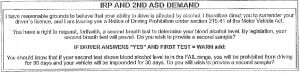
As you can see, the Right is not labeled as a Right. It is labeled as a Demand. This is important. When the police make a Demand in a drinking driving case, they must do so right away — not when they are serving the documents at the end of their investigation. So what we see happening all of the time is that if the police read this Demand, they do it right after the breath-test result — not when the Right arises. How does this screw things up?
If the person says they want to blow again and the police comply it is usually done immediately, so there is no chance to eliminate mouth alcohol. So if there is mouth alcohol, the second sample can be as unreliable as the first. This defeats the argument that the second sample is a safeguard from wrongful prohibitions.
The second problem is that most people have no idea about the jeopardy they face at the point in time that the officer reads the Demand. They don’t know what a Warn or Fail means, and there is nothing in the Demand about what they blew. Often the police will not tell people what they blew until they serve the documents.
Because it is labeled a “Demand” and not a “Right” the police interpret it as something that they do not need to provide. It does not carry the same weight as a Right.
Finally, the police ask for a response at the moment they read the second test Demand. Many people, not knowing what is happening, will decline to blow again. When the police attend to serve the documents it is common for people to ask for the second test. Almost always the police will refuse to do it. Why? Because when you refuse a Demand in a drinking driving investigation, the refusal becomes fixed and the officer is instructed to not permit further testing. And besides, from their point of view it is not a Right.
We don’t blame the police for this. Well, actually we do because the high-ranking police officers in British Columbia should have known better. It is designed to thwart the driver’s right to a second test and it is needlessly confusing for officers trying to do things correctly at the roadside. It also provides plenty of opportunities for the few police officers who are jerks to behave like jerks.
From our perspective, the second test was designed to fool the Court in any judicial challenge of the legislation. It is designed to look like it is some sort of quality control, but it does not serve that purpose. If you refuse a second test, you look guilty. If you provide a second sample, it is no more likely to be correct as the first.
So, as we said, the second test is 100% bullshit. The police are not required to inform people of it, the scheme is designed to thwart your right to a second test and even if you blow again, the way the police do it does nothing to reduce the possibility that the second test is as screwed up as the first.
If you received a IRP give us a call. We’d like to speak with you.